Monday, February 21, 2011

Teckdeck Collectors Item

Film of the Week - February 23

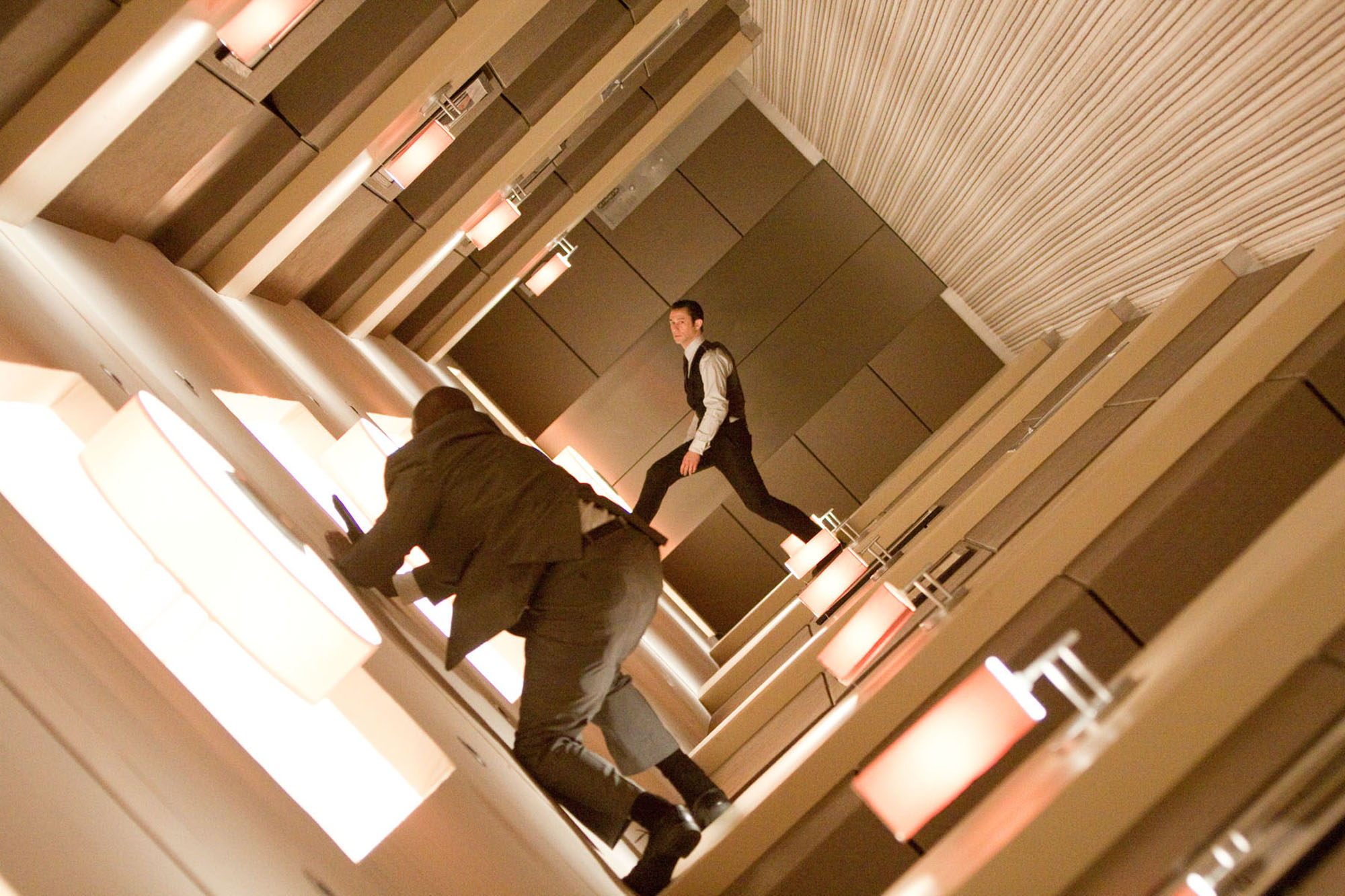
Inception of Christopher Nolan


Synopsis
Sun Cobb is a thief, a thief of dreams, a that enters the heads of people and passing of secrets and dreams in dream research hidden information. At the service of industrial espionage, and his team this time is not trying to steal, but to engage in the mind of a young scion of a controversial idea, but the adventure continues and is more complicated, more Cobb understands him to be the real protagonist dreams in which plunges wildly.


rare example of a blockbuster author, film business financed with millions of dollars, played by star, sold in almost every country in the world, but thought by its author with an almost absolute freedom - what no longer possible in Hollywood, unless you're not the director of the last two Batman - Inception is a work that delves deep into a dream brings another dream another dream, and yet, by the recurrence a movement that does not play a copy, but it varies and increases the space and time in infinite measure. The movement of the film is double, because on the one hand shuns reality to immerse themselves in the dream dimension, but the other is immersed more and more to the crux of the narrative, trying to resolve the trauma that alters the very reality from which he fled.

In this sense, Inception is a classic movie that plays perfectly with the basic elements of Hollywood storytelling, with the effects of condensation and displacement, with a structure of poems (the return of memories / dreams of Cobb), substitutions ( the presence of his wife Mal, that in every dream turns into an enemy different) and broken (still Mal, which appears as a reflection of the unconscious and forced to move from level to level) representing the source of story. In

Inception is a dream - better, more dreams - and dreams, the symbols, are the film itself, its obsessive quest for a primal trauma. A trauma that led to any form of story and that turns out to be the emotional trauma of separation, the inability to unite with each other (hence the inevitable creation of infinite worlds are always different from the dreams of each individual) and the failure of self-realization in the pair, then in the family, that American cinema classic is the only form of reality as possible.

The bond between a father and a son (who himself lives on Cobb If, with a father who abandoned their offspring) is what the heroes of the film trying to change, so entering into a sort of resounding primal scene of American cinema. With Inception is as if we ventured for the first time in place of the unspeakable, what you should not show: a trip is built step by draw, dream after dream, in which Christopher Nolan get to talk about same core of classic cinema. It is a journey that every movement penetrates the appearance of speech. Every dream is a blow to the film surface, the structure, represented with an extraordinary process of visualization as a physical place exists: or the personal imagery of the protagonist, the island overflowing with buildings that collapsed with the transition from a dream to the next, and fragile encyclopedic accumulation of memories, desires, hopes, obsessions.

staging city that doubled up and came back to bite them, imaginary cities that collapse to leave the skeletons of the structures, Inception gives visual form to the dreams that architecture is one of the key issues of our society: the space is the real star the film, while the time an object is used and its context. Here the space is the projection of desires and extent of the failures, it is imagination above the sense of measure, that doubles infinity, mirror against a mirror, the figure of a man placed in an urban environment, by moving out equal and opposite to that, however, leads to a single port and is recognized and recognizable: the house from time American cinema. Because even

Inception finds its culmination so far is the heart of every classic film in the symbolic dimension that is family and that place is just as symbolic of the house. Overturning a formula often used to define the melodramas, one could say that here Heart Is Home Is Where The "is where the heart is home." As already Shutter Island of Scorsese, with whom Inception has several points in common, the house indicates the end of a wandering mind in particular. The difference is that Scorsese choose an imaginary movie buff ( Her to Heaven by John M. Stahl), while Nolan re-contextualizes the iconography of the American house.

The DiCaprio of Inception , such as goat Shutter Island, in the final of fi lm
enters a house where lies the origin of every dream, so each story. The house in which it waits for the woman he loved and lost stands alone and untouched in a cluster of crumbling skyscrapers, the strangeness construction of the place in which it appears it is clear, his appearance refers to the known and familiar form of a primitive place. Building the film as a continuous cleavage of narrative units, space and time, Chinese boxes that contain each other and slip over one another, Nolan brings me to the heart of the film, the American family home inside it contains another box (safe), which in turn contains the object-totem of the film, the spin, the objective correlative of a world constructed from continuous centrifugal forces, but contained in a single element which no coincidence that it moves only on itself, without progress in space.
The top of
Inception , which leaves doubt as to the real end of the journey, is the sign of the contradictions of American cinema: the desire to match everything to resolve any repetition, and at the same time the fatal necessity of reviving the 'idea of \u200b\u200basymmetry and therefore the possibility of building other countless ways, countless times and endless stories. Inseparable in its smallness, the film focuses in part, as well as the blue box Mullholland Drive embodies Film Lynch. But what the world was a double outlet, the suction in the darkness of death and rebirth that gave rise to a potentially infinite film, able to build any world from its own elements, there is a movement that enshrines the perpetuation of the cinema as the construction of dreams, but also the fragility and the failure of all its construction: the usual places for each port are always there, always symbols of the usual emotional trauma, with the waves that fold in on themselves and mimic the forward movement of the film, slowed by a push in the opposite direction. When we dream, after all, we are convinced that they can not get out of the dream.

Tuesday, February 15, 2011

Vehicle Inspection Sticker Maine

Cineocchio - Film of the week, February 16

Passion of Carlo Mazzacurati


Synopsis
The tragicomic story of filmmaker John Dubois, a former promise of the cinema in disgrace, on the eve of the return on the screens with a film starring a young and popular television actress, is locked in a small town in Tuscany, and here reluctantly forced to head the popular representation of the Passion of Christ.


is symptomatic of the current state of the country if the Italian cinema has long since been eaten by the television and if the dialogue between the two is strongly unbalanced by the second. Television has won the battle for popularity and seduction Collective film and therefore has earned the right to speak first, to create characters and comic figures who thrive on the small screen and then there's also a great comment on. With Checco Zalone and Cetto La Whatever , to remain the last blatant examples, it went like this: the TV has launched the smash and films that followed have been limited to ennoble or to prolong their existence. The cinema, or at least the commercial cinema and comedy in which recovery is normal and spectator needs, not to pursue the televised speech, but only repeats, the maximum extension.

Carlo Mazzacurati , which is a real director and not a performer, as Gennaro Nunziante or Giulio Manfredonia, knows this and when he decides to run an Italian comedy dated 2010 is at the edge of the problem, a first step yield dynamics television, a step beyond the ability to think in terms of comic cinema. His passion laugh, laugh a lot, but it does so as a successful and well-written fiction: with the rapid sketch comedy, with sketches of the characters who prevail on their psychological definition, with the presence of Corrado Guzzanti which simply update her gallery of magnificent and horrible freak television. The same comic vitriol on the world of Italian cinema, which created the funniest jokes in the film, is nothing but the repetition of verve acid Boris, his self-indulgence and good nature of his disguised malice.

is not to pillory colleagues and opponents who would like to Mazzacurati , even with all the irony and fun uses. Nor is the ingenuity of the province to interest, having previously crossed, and with much greater force, that world of structured ambiguity. Rest is a painter of landscapes, human and social, but with the understanding that the impairment of vision television has permanently altered the ability to discern reality. The world on stage, superficial and Sketches, with a spot of Tuscany and a language to the vernacular, is the only one at the moment the comedy films can afford, the only game that the public agrees to play to get to laugh.


Passion then is the story of creative impotence which results in existential impotence. The inaction of John Dubois, director without inspiration and unable to lead a popular representation that seems to go on stage alone, like a film without a director, like any product comic Checco Zalone or Ale e Franz , is the sign of the defeat of the cinema than on television. There is not Mazzacurati behind the stereotypical image of the impoverished former promise, there is the very idea of \u200b\u200ba historic defeat, the superficiality of any talk conducted with the rules imposed by the television show.

Everything is flat, two-dimensional, built: not, however, as the tableau of a medieval passion, but as a screen without depth. It is no coincidence, then, that anger at one point he vents not as a reaction to bad luck, but as outrage at the shameless mockery of the common viewer, insensitive to the point of laughing a fat man falls to the ground and did not notice to attend a performance of true three-dimensional representation of the real passion of a modern, the only possible today: passion, that is, the different, the last of the single subjectivity which does not adapt collective emotion and therefore deserves ridicule and rejection.

It is no coincidence, then, that once broken the veil of anything with which he wrapped up his play (inevitably) television Mazzacurati chooses to close his film with another film, which is independent cinema at least , created by the mind finally free of Dubois and then unveiled the story, a story of escape and liberation chooses to place a character on the edge of a world to discover, beyond which lie the unknown, the unexpected, the new perhaps.

Friday, February 11, 2011

Necessary Boho Clothes

Film of the week - February 9

The Prophet of Jacques Audiard


Synopsis
The nineteen year old Malik was sentenced to six years in prison. Young and fragile, but despite being nearly illiterate extr intelligent, Malik begins to carry out "missions" for a group of inmates courses that have imposed their own law within the penal institution. Over time, the boy gained their full confidence soon able to exploit the situation to their advantage.


The film may contain a gender? How the world can get into a movie? Majestic for life and ambitions, the prophet openly challenge their idea of \u200b\u200bthrowing bombast in the field laws (fundamental but unwritten) of cinematic storytelling.

First, the space : a Parisian prison, a place complete, anonymously, a no man's land where the national identity, dispersed in a globalized society and for this contested by political forces as a weapon of offense, it retrieves the value of ethnicity and belonging, "tribal" to decide the survival or abuse of any prisoner. Then, the time : endless, as for all those who end up in, no matter if sentenced to one year or thirty, time slows down and speeds up, time to wait at the decisive moment that can cut or save a life . Then a face and body, a hero Malik, played impressive Tahar Rahim, a statue of impassivity that strengthens gradually with the knowledge of prison rules and awareness of its value without changing expression, rigidity of classical form on which to project the identification of the viewer. Finally, the world and its infinite stories: stories of political prisoners with the time course become gangsters, thugs killed in a test of courage that look like ghosts, fellow lock with cancer, a widow and to care for a child, stories of secret wars between North African and French, of unknown languages \u200b\u200bto learn to save his skin, stories of power and control, ambition and fear. Stories of Men, in short.

Men Audiard, from Malik, does not forget never to put at the center of his film, the first of the narrative and the rules of the prison film, turned over the structure of the genre, staging what is the rise to power of a prisoner smart and brave, but especially the history of its survival, its reaction to that very human thing that is fear.

is that, in fact, that the prophet speaks : instinct, a guy who works to win and not die, what reason coolly on its choices in response to a desire for animal life. The genus survives the fall and rebirth of his parable, because it never overpowers the central and at the same time does not waive its own rules, to their drift (the ghost of the first victim of Malik, premonitions almost divine, the final impression biblical ironically) and improbabilities (all those dead in central Paris and no one bat an eye!). Rather, an event that crosses subtrack Malik in the heart but that never fails to regenerate, to breathe like a piece of real life.

Malik is the privileged view of the story, his physical presence is the source of each event, but in his lonely battle to get to guide the institution that has locked up is just one of many pieces, the main, prepared by world Audiard. That world exists outside of prison and finds space not only in the temporary exit of Malik, but also in the faces of men and women in the scenes glimpses of the parlor, past the shoulders of the protagonist and beyond the lifetime of each scene, thanks to ' delay of the camera.

There is a continuous breath that pervades the images and stories of the prophet . Audiard handles extraordinarily fluid that accumulates on the gusset piece, choosing to divide it into several chapters to important and useful life, devoted to each character met in prison Malik. A structure that, without fearing the risk of comparison, has reminded us that of Rocco and His Brothers , because basically it is the pitch masterpiece maximalist Audiard has miraculously found. The pace of the story that embraces all and understands all pleased to enclose an anxiety in life within the cinema.

Tuesday, February 8, 2011

Distributing Monster Energy Drink

Cineocchio 2011, we begin


From begin Wednesday, February 16, the projections of cinecircolo The Cineocchio : 12 films of the current season, witnessing the best Italian distribution between 2010 and 2011, often unknown in the city Alba and from around the world. Projections on Wednesday
and Thursday of each week. Ordet Hall, Sunrise: 20:45
passes at 20 €, available at: Library Tower - Saint Paul Library - Video Library Casablanca.

It begins with passion Carlo Mazzacurati (Ita, 2010). And to follow:

February 23 Inception Christopher Nolan ( id. , U.S., UK, 2010)

March 2 men of God Xavier Beauvois ( Des hommes et des Dieux , Fra, 2010)

March 9 Potiche - the genius that was my wife by François Ozon ( Potiche , Fra, 2010 )

March 16 Post Mortem Pablo Larraín ( id. , Chile, 2010)

March 23 The Social Network David Fincher ( id. , USA 2010)

March 30 Animal Kingdom David Michod ( id. , Aus, 2010)

April 6 Gorbaciòf Stefano Incerti (Ita. 2010)

April 13 American Life by Sam Mendes ( Away We Go, USA, 2009)

April 20 Hereafter Clint Eastwood ( id . , USA, 2010)

April 27 I am with you by Guido Chiesa (Ita, 2010)

May 4 In a better world by Susanne Bier ( Hævnen , Dan-Swe, 2010)